
Senior surgeon review
Your case is reviewed for clinical fit before a date or package is suggested.
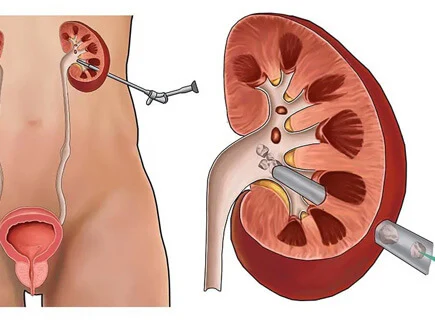
Some kidney stones grow too large for laser-only or shock-wave treatment. Stones bigger than about 2 cm - including branched 'staghorn' stones that fill the kidney's collecting system - often cause repeated infections, blood in urine and gradual, silent loss of kidney function. Ignoring them risks permanent damage, so complete clearance in the fewest possible sittings becomes the priority for these patients.
PCNL (percutaneous nephrolithotomy) is the gold-standard treatment for large kidney stones. Through a small keyhole opening on the back - usually under 1 cm with modern Mini-PCNL instruments - the urologist reaches the stone directly, breaks it using laser or pneumatic energy, and removes the fragments immediately. Because pieces are physically extracted rather than left to pass, PCNL offers the highest single-sitting clearance rate for big stones.
At Axten Hospitals, PCNL is performed only by specialist urologists experienced in miniaturised techniques. You get one honest, all-inclusive package price covering surgery, anaesthesia, room, medicines and consumables - zero surprise billing, cashless insurance support, 0% EMI, a dedicated care coordinator and free post-surgery follow-ups until you are confirmed stone-free.
Share your details - a care coordinator calls you back within minutes.
A non-contrast CT scan (NCCT KUB) is the key investigation for large stones - it maps the exact size, branching pattern, density and position of the stone, and helps the urologist plan the safest keyhole track into the kidney. Ultrasound and X-ray KUB support the initial assessment and later follow-up.
Blood tests (creatinine, electrolytes, blood counts, sugar) assess overall kidney function and fitness for anaesthesia, while urine culture identifies any infection that must be treated with antibiotics before surgery. In selected cases a nuclear renal scan is added to measure how much each kidney is actually working.
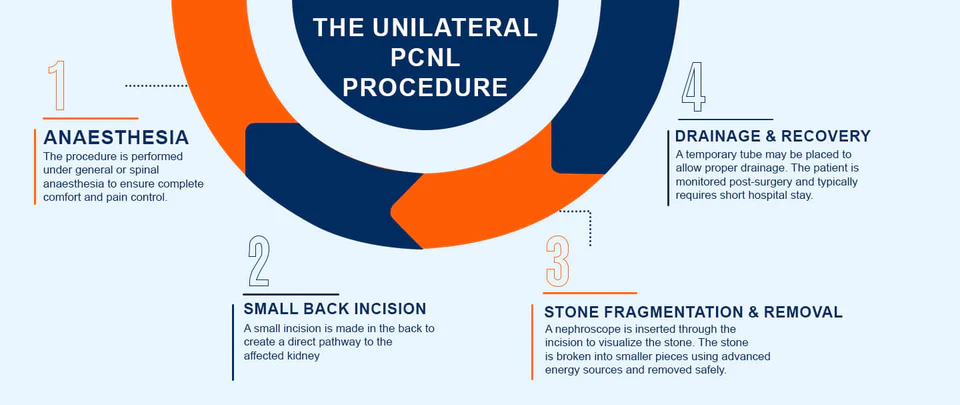
PCNL is performed under general anaesthesia and typically takes 60-90 minutes. Guided by X-ray or ultrasound imaging, the urologist makes a small puncture on the back and creates a narrow track directly into the kidney's collecting system, then slides a slim telescope down this track to see the stone clearly on the monitor.
The stone is fragmented using a laser fibre or pneumatic lithoclast, and the pieces are actively suctioned or extracted through the track - this immediate removal is what gives PCNL its superior clearance for large stones. At the end, a DJ stent and sometimes a small temporary tube in the back are placed to protect the kidney while it heals.
Most patients are out of bed the same evening and go home in one to two days. Any tube in the back is removed before discharge, and the DJ stent is taken out in a short day-care visit a few weeks later, after an X-ray confirms complete stone clearance.
Why Axten
Every kidney stone removal (small incision) package includes your surgeon's fee, OT and anaesthesia charges, hospital stay, standard medicines and post-procedure follow-ups - quoted once, in writing, before you decide.
Share your reports on a free call. A specialist reviews your case the same day.
Receive one all-inclusive package price in writing - before you commit to anything.
Our insurance desk secures cashless approval and completes every formality.
A senior specialist operates at a partner hospital near you, on your scheduled date.
Free follow-up consultations and recovery monitoring until you are fully healed.
The Axten standard
For kidney stone removal (small incision), Axten focuses on the parts patients usually find stressful: confirming the right specialist, explaining the procedure clearly, locking the package price in writing and keeping recovery follow-ups organised.
Your case is reviewed for clinical fit before a date or package is suggested.
Surgeon, OT, anaesthesia, stay, standard medicines and follow-ups are itemised upfront.
Cashless eligibility, TPA paperwork and EMI options are checked before admission.
A care coordinator keeps follow-ups, reports and recovery instructions organised.
Free specialist consultation and an honest all-inclusive quote - no obligation.