Advanced Hip Replacement Surgery

AdvancedSpecialist surgeons onlyCashless insuranceFree follow-ups
Hip replacement surgery consultation
Hip Replacement Surgery - specialist-led treatment at Axten

The hip is a ball-and-socket joint that carries your body weight with every step. It can fail in two common ways: gradual damage from arthritis or avascular necrosis (loss of blood supply to the ball), and sudden fracture of the hip - especially the femoral neck - after a fall in older adults. Both cause groin or thigh pain and can take away the ability to walk independently.

Hip replacement surgery replaces the damaged ball, and usually the socket, with smooth, durable artificial components. It reliably relieves pain and restores walking, and for elderly patients with hip fractures it is often the treatment that gets them out of bed within days - vital, because prolonged bed rest in the elderly leads to serious complications.

At Axten Hospitals, hip replacement is performed only by specialist joint replacement surgeons, with fracture patients fast-tracked for surgery within 24-48 hours whenever medically possible. One honest all-inclusive package covers implant, surgery, stay and physiotherapy, supported by cashless insurance, 0% EMI, a dedicated care coordinator and zero surprise billing.

Honest all-inclusive price₹1,80,000 - ₹3,50,000 (all-inclusive, varies by implant type, fixation & city)See full cost breakdown

Consult for Hip Replacement Surgery

Share your details - a care coordinator calls you back within minutes.

Country code +91 selected.

100% confidential · No spam · Honest all-inclusive quotes

Symptoms of Hip Arthritis & Fracture

  • Pain in the groin, outer hip or thigh, sometimes felt in the knee
  • Stiffness that makes wearing footwear, cutting toenails or sitting on the floor difficult
  • A limp, or the sense that one leg has become shorter
  • Pain at rest or at night in advanced arthritis or avascular necrosis
  • After a fall - severe hip pain, inability to stand, and a leg that looks short and turned outward
  • Steadily reducing walking distance despite medicines

Risks of delaying treatment

  • In elderly fracture patients, delay and bed rest invite bedsores, pneumonia, clots and rapid loss of strength
  • Untreated avascular necrosis progresses to collapse of the ball, ruling out simpler joint-preserving options
  • Advancing arthritis stiffens the hip and weakens muscles, making surgery and rehabilitation harder
  • Ongoing pain and immobility erode independence, confidence and overall health in a matter of months

How is hip arthritis & fracture diagnosed?

For arthritis and avascular necrosis, diagnosis rests on a clinical examination of hip movement and gait, together with X-rays of the pelvis and hip. An MRI is added when early avascular necrosis is suspected, since it can show the condition before X-rays change. For a suspected fracture after a fall, an urgent X-ray confirms the break and its exact pattern, which determines the best operation.

Because many hip patients are elderly, a careful fitness assessment - heart, lungs, kidneys, diabetes control and bone health - is done before surgery. At Axten, this evaluation is completed rapidly so that fracture surgery is not delayed, and the physician, anaesthetist and surgeon plan the safest anaesthesia and implant strategy together.

Benefits of advanced treatment

  • Reliable, lasting relief from hip pain - among the most successful operations in medicine
  • Restores independent, confident walking and corrects limp and leg shortening
  • Enables elderly fracture patients to be out of bed within a day or two
  • Prevents the dangerous complications of prolonged bed rest after hip fracture
  • Modern bearing surfaces give implants a lifespan of 20 years or more
  • One honest all-inclusive price with cashless insurance and 0% EMI support

Types of hip replacement surgery

Non-surgical options

  • Physiotherapy and activity modification - useful in early arthritis to maintain strength and movement.
  • Medicines for pain and bone health - including treatment of osteoporosis to prevent future fractures.
  • Walking aids - a stick or walker to offload the joint and prevent falls.
  • Bisphosphonate therapy and core decompression referral - options in very early avascular necrosis, before the ball collapses.

Surgical & procedural options

  • Total hip replacement - both the ball and the socket are replaced; the standard for arthritis, avascular necrosis and fit, active fracture patients.
  • Hemiarthroplasty (partial replacement) - only the ball is replaced; a quicker operation often chosen for elderly patients with femoral neck fractures.
  • Cemented and uncemented fixation - the implant is either fixed with bone cement or press-fitted for bone to grow onto, chosen according to bone quality.
  • Revision hip replacement - exchange of a worn or loosened implant using specialised components.
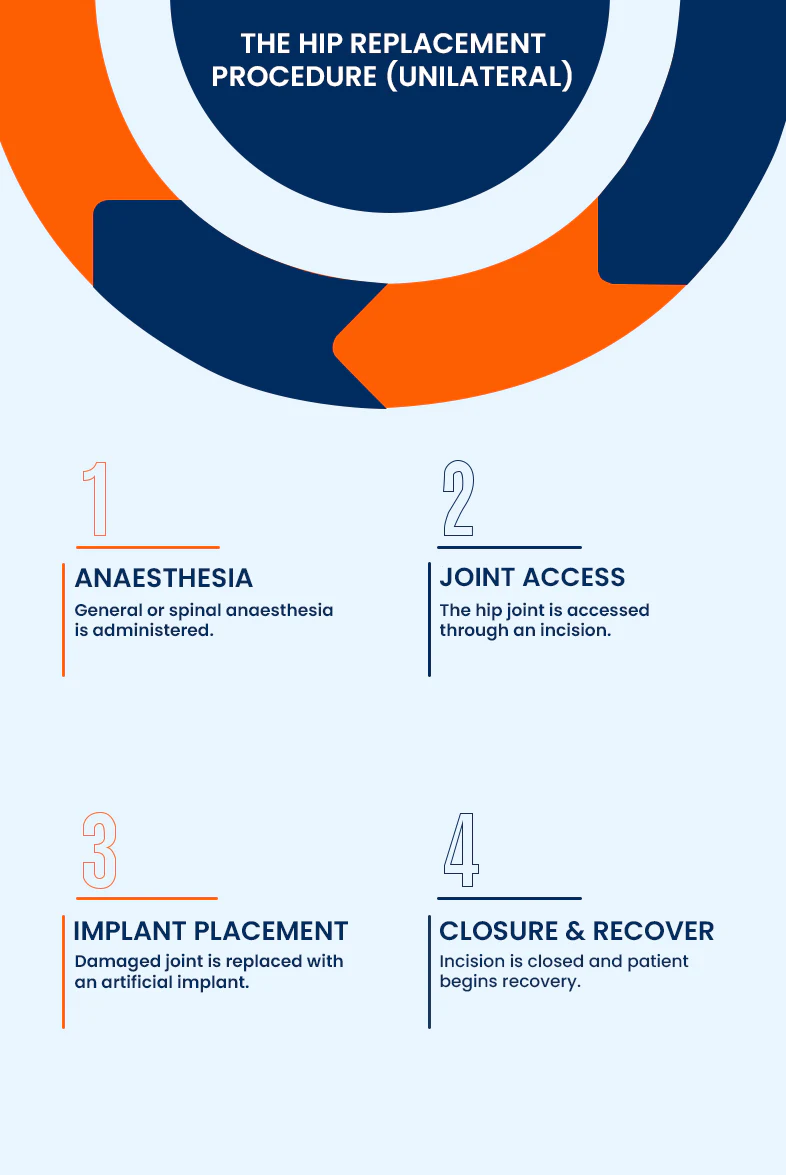
Unilateral hip replacement procedure overview
How hip replacement surgery is performed

How the procedure is performed

Hip replacement is performed under spinal or general anaesthesia and takes about 60-90 minutes. Through an incision over the hip, the surgeon removes the damaged ball of the thigh bone and prepares the socket. In a total replacement, a new socket liner and a stem with a smooth ball are implanted; in a hemiarthroplasty, only the ball and stem are replaced.

The choice between cemented and uncemented fixation is made according to your bone quality - cement gives immediate strong fixation in osteoporotic bone, while uncemented implants allow bone to grow onto them in younger, stronger bone. Either way, the new joint is tested for stability and leg length before closure.

Most patients stand and walk with support within 24-48 hours of surgery. Hospital stay is typically four to six days, with physiotherapy sessions daily. Before discharge, you are taught the simple hip precautions that protect the new joint, and your care coordinator schedules your free follow-up visits and home physiotherapy if needed.

Recovery & aftercare

  • Walk with a walker from day one or two, progressing to a stick and then independent walking over 4-6 weeks
  • Follow the hip precautions taught to you - avoid low stools, squatting and crossing your legs in the early weeks
  • Use a raised toilet seat and a firm chair with armrests during the first month
  • Keep the wound dry until healed and take the prescribed blood-thinning medicines to prevent clots
  • Continue calcium, vitamin D and any osteoporosis treatment to protect your other bones
  • Attend all free follow-up visits so walking, wound and X-rays can be reviewed on schedule

Why Axten

Care that doesn't stop at the operating table

Every hip replacement surgery package includes your surgeon's fee, OT and anaesthesia charges, hospital stay, standard medicines and post-procedure follow-ups - quoted once, in writing, before you decide.

  1. Talk with our experts

    Share your reports on a free call. A specialist reviews your case the same day.

  2. Honest fixed quote

    Receive one all-inclusive package price in writing - before you commit to anything.

  3. Insurance & paperwork

    Our insurance desk secures cashless approval and completes every formality.

  4. Your procedure

    A senior specialist operates at a partner hospital near you, on your scheduled date.

  5. Recovery & follow-ups

    Free follow-up consultations and recovery monitoring until you are fully healed.

The Axten standard

Why patients choose Axten for hip replacement surgery

For hip replacement surgery, Axten focuses on the parts patients usually find stressful: confirming the right specialist, explaining the procedure clearly, locking the package price in writing and keeping recovery follow-ups organised.

NABHstandard partner hospitals
100%written package quotes
24x7care helpline access

Senior surgeon review

Your case is reviewed for clinical fit before a date or package is suggested.
One written package

Surgeon, OT, anaesthesia, stay, standard medicines and follow-ups are itemised upfront.

Insurance handled early

Cashless eligibility, TPA paperwork and EMI options are checked before admission.

Coordinator-led recovery

A care coordinator keeps follow-ups, reports and recovery instructions organised.

FAQs about hip replacement surgery

My elderly parent has fractured a hip. Is surgery really necessary at this age?

In most cases, yes - and the earlier the safer. Without surgery, an elderly person with a hip fracture is confined to bed for months, risking bedsores, pneumonia, blood clots and severe weakness. Hip replacement or fixation gets them standing within a day or two. Age by itself is rarely a barrier; fitness is assessed carefully and anaesthesia is tailored accordingly at Axten.

What is the difference between total and partial hip replacement?

In total hip replacement, both the ball and the socket are replaced - the standard choice for arthritis, avascular necrosis and active fracture patients. In partial replacement (hemiarthroplasty), only the ball is replaced, which is quicker and often appropriate for elderly patients with limited walking demands. Your Axten surgeon recommends the option that best matches your age, bone quality and activity level.

How soon after a hip fracture should surgery be done?

Ideally within 24 to 48 hours of the injury, once essential fitness checks are complete. International evidence clearly shows that early surgery reduces complications and improves survival in elderly fracture patients. Axten fast-tracks hip fracture admissions - evaluation, cashless insurance approval and operating theatre scheduling are handled in parallel by your dedicated care coordinator so precious time is not lost.

How long will the hip implant last?

Modern hip implants routinely last 20 years or more, and improved bearing surfaces are extending that further. Longevity depends on implant quality, surgical accuracy, bone quality and activity habits. Axten uses only internationally proven implants and documents the exact make and model in your records - so you always know precisely what is inside you and what it cost.

When can I walk, climb stairs and return to normal life after hip replacement?

Most patients walk with a walker within one to two days, manage stairs before discharge, and walk independently by four to six weeks. Office work is usually possible by four to six weeks and driving by six to eight. Complete recovery of strength continues for about three months. Elderly fracture patients progress a little more gradually, with physiotherapy support at every step.

What precautions are needed after hip replacement?

For the first six weeks or so, avoid squatting, sitting on very low stools, crossing your legs and twisting sharply on the operated leg - these positions can strain a healing hip. Use a raised toilet seat and firm chairs. After the muscles heal and strengthen, most everyday activities, walks and travel resume freely. Your Axten physiotherapist demonstrates every precaution before you go home.

What does hip replacement cost at Axten Hospitals?

Hip replacement at Axten typically costs between ₹1,80,000 and ₹3,50,000, depending on whether it is a partial or total replacement and the implant selected. This is an honest, all-inclusive package - implant, surgery, anaesthesia, stay, medicines and physiotherapy - with zero surprise billing. Cashless insurance and 0% EMI are available. Call 8156-92-92-92 for an exact estimate.

What is avascular necrosis (AVN) of the hip, and does it always need replacement?

AVN means the ball of the hip joint loses its blood supply and slowly weakens, eventually collapsing. It affects younger adults too, linked to steroid use, alcohol and certain medical conditions. Caught very early, joint-preserving treatments may help. Once the ball has collapsed and pain limits life, total hip replacement is the reliable solution. An MRI at Axten can stage AVN accurately - call 8156-92-92-92.

Ready to discuss hip replacement surgery?

Free specialist consultation and an honest all-inclusive quote - no obligation.